How to Compare Fundraising Platform Fees for a Small Nonprofit
Compare written platform and processing terms, donor tips, subscriptions, refunds, and payout rules using a practical net-proceeds worksheet.
By SuperFundraiser Editorial
Quick answer
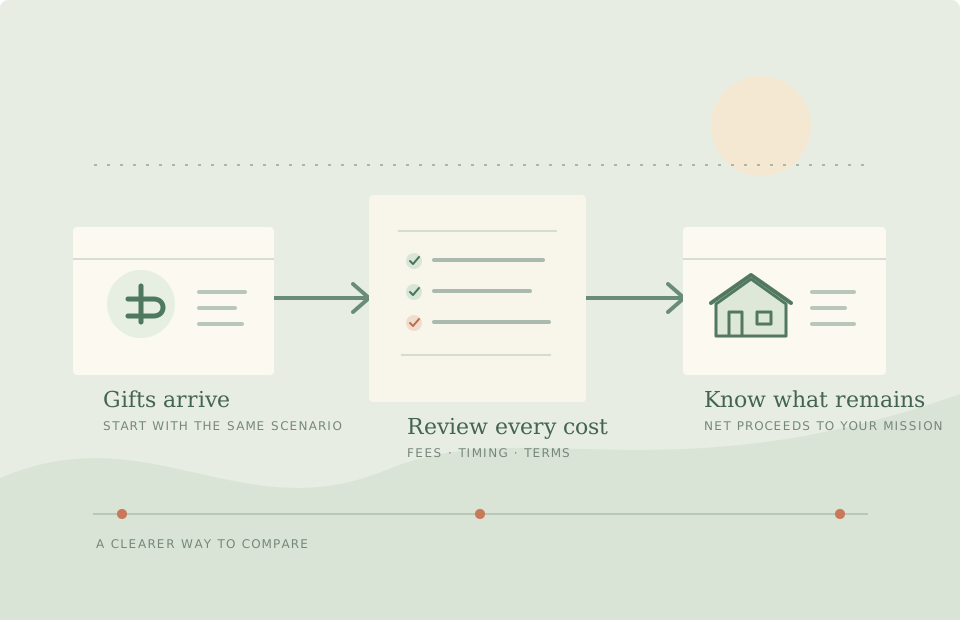
Compare fundraising platform fees by putting every candidate's written terms into the same small campaign budget. Identify who pays each charge, what amount the charge is calculated on, when it is collected, and what survives a refund or dispute. Then show three separate totals: the donor's checkout payment, the nonprofit's net proceeds, and cash available by the date you need it. A low advertised rate can look quite different once a subscription or payout delay is included.
This is a cost-comparison guide, not a ranking of providers. The provider examples below describe pricing models, without ranking them or predicting results. If you are still choosing donation software, start with our platform-selection guide. For broader contract and vendor checks, use How to Compare Fundraising Companies. Here, the job is narrower: make competing fee terms comparable enough for a staff member and finance lead to review together.
Get the terms that would apply to your account
Ask each candidate for its current fee schedule, service agreement, payment-processing terms, and a written quote where relevant. Save the documents, their dates, and the plan name. A public pricing page may not describe your account's negotiated terms, payment methods, currency, or billing period. Ask the provider to resolve inconsistencies in writing rather than choosing whichever document looks cheapest.
Use a realistic gift mix before doing arithmetic. A card payment, bank payment, foreign-currency gift, or recurring installment may have different charges. Record the number of successful payments, typical gift sizes, campaign duration, and whether the organization will pay for software between campaigns. Ten monthly installments can mean ten fixed transaction charges, not one.
For every fee, complete this sentence: “This party pays this charge, on this base, at this time, under this condition.” If you cannot finish it, the quote is not ready to compare. The FTC's guidance for online giving portals emphasizes clarity about fees and how much reaches the designated charity. Ask for the same clarity in your staff-facing documents.
Separate processing, platform, and subscription charges
Processing fees pay for handling a payment; platform fees pay for the fundraising service. A subscription pays for access over a billing period. These are different costs even when a provider combines them on an invoice. Copy percentage charges and fixed per-payment charges into separate worksheet rows, and confirm whether either is deducted from payouts or billed later.
Do not assume percentages share the same base. One charge might apply to the intended donation; another might apply to the entire checkout payment, including a donor-paid contribution toward fees or an optional tip. Ask for an example using your gift size. Record minimum charges, annual commitments, cancellation dates, additional-user or feature charges, setup costs, and required integrations. Allocate an annual subscription across the period you are comparing, but also show the actual cash payment due.
Keep fundraising software costs separate from costs of the campaign itself, such as printing or paid promotion. You can include those expenses in the final campaign budget without pretending they are platform charges. This makes it easier to explain whether a smaller net amount came from payment terms or a separate spending decision.
Check current pricing models against your settings
Official pages checked October 10, 2026 show why a fee headline needs context:
| Provider | Stated model | What to verify |
|---|---|---|
| Givebutter | With optional tips enabled, nonprofit platform and processing fees are covered. With tips disabled, it lists a 3% platform charge plus standard processing: 2.9% + $0.30 for cards or 1.9% + $0.30 for ACH. | Account eligibility, checkout settings, payment methods, exceptions, and any optional Plus subscription. |
| Zeffy | Says it covers platform, credit-card, and transaction fees through optional donor contributions. Donors may decline the contribution. | Organization and country eligibility, the donor's checkout total, and applicable payout terms. |
These are provider-stated terms, not negotiated quotes or endorsements. Both links are ordinary source links, not SuperFundraiser affiliate links. Save the applicable official terms and request written clarification before budgeting. Provider-funded fees, donor tips, and affiliate commissions are separate amounts with different recipients.
Identify who bears the charge at checkout
“Donors can cover fees” does not mean they always do. Compare an uncovered-gift case first. Then model any donor-covered case separately using the provider's actual calculation, not a guessed participation rate. A suggested amount may be rounded or calculated on the larger checkout total. Ask whether the nonprofit still owes anything if the donor declines.
An optional tip to a platform is not the same as a required fee, and it is not automatically money for your nonprofit. Record its recipient, whether it is preselected, how to set it to zero, and whether processing charges include it. Show donation, optional tip, required charge, and final debit separately. Do not add money received by another party to your proceeds.
Have someone try the mobile checkout without helping them. Can they identify which amounts are optional and complete the gift without accepting a tip or fee-coverage suggestion? Save screenshots for the team's review. A voluntary donor payment may reduce the organization's costs, but it still affects what the donor sees and pays. The FTC's donor guidance on fundraising platforms is a useful companion for reviewing fee disclosures and the path funds take to a charity.
Compare the same campaign with hypothetical arithmetic
The following rates are invented solely to demonstrate the calculation. They are not provider prices, quotes, expected results, or endorsements. Assume 100 successful card gifts of $25: $2,500 in donations, no donor-covered fees, no tips, and one monthly billing period. In this example only, every percentage applies to the $2,500 donation total.
| Cost or result | Hypothetical A | Hypothetical B |
|---|---|---|
| Donation total | 100 × $25 = $2,500 | 100 × $25 = $2,500 |
| Processing percentage | 2.5% × $2,500 = $62.50 | 2% × $2,500 = $50 |
| Fixed processing charge | 100 × $0.20 = $20 | 100 × $0.30 = $30 |
| Platform percentage | 1% × $2,500 = $25 | None in this example: $0 |
| Subscription for the period | None in this example: $0 | $30 |
| Total modeled charges | $107.50 | $110 |
| Net before refunds and disputes | $2,392.50 | $2,390 |
A has a platform charge and B does not, yet their modeled net amounts are close. Neither is a real platform recommendation. Change the gift sizes, payment count, or billing period and the comparison can change. For example, with just 20 gifts of $25 under these same invented terms, A's charges are $12.50 + $4 + $5 = $21.50, while B's are $10 + $6 + $30 = $46. The fixed subscription matters more at that smaller volume.
For an actual candidate, use donations received minus charges borne by the nonprofit minus refunded or disputed gift amounts, plus any fee credits. Add separate campaign expenses if you want a whole-campaign net figure. Use transaction-level rounding rules from the provider, since rounding each gift can differ from applying a percentage once to the total. Never include unknown charges as zero.
Stress-test refunds and disputes
Ask what happens to the original processing charge and platform charge after a full or partial refund. Is either returned? Is there an additional refund fee? What happens to a donor-paid tip or fee contribution? The answer may depend on the payment method and timing. Ask for sample ledger entries that show the gift, refund, retained fees, and any credits.
A dispute is not simply a refund with a different name. Confirm any dispute administration charge, response deadline, evidence process, and whether winning the case reverses the fee. Ask how the provider handles a negative balance or a disputed gift after the money has been transferred to your bank.
Here is a separate hypothetical stress case using A's $2,392.50 starting net above: one $25 gift is refunded, a different $25 gift is lost to a dispute, and an invented $15 dispute charge applies. Assume none of the original fees are credited and there are no other charges. Net proceeds become $2,392.50 − $25 − $25 − $15 = $2,327.50. Do not subtract those gift amounts twice by also removing them from a gross total that already excludes them.
This is a sensitivity check, not a prediction of refund or dispute frequency. Replace every assumption with written terms, and label anything the provider has not answered as unresolved.
Distinguish net proceeds from available cash
Payout timing can matter more than a small difference in fees when a bill is due. Record the normal payout schedule, first-payout conditions, minimum transfer balance, transfer charges, bank-arrival timing, verification requirements, and rules for weekends or holidays. Ask what happens if bank details fail validation, a transfer is rejected, or account review pauses payouts. Who must take action, and which charges apply?
A reserve or hold is not automatically an expense. If, in the stress case above, an invented $200 hold temporarily restricts otherwise payable proceeds, $2,127.50 may be available now while $200 remains held. The $2,327.50 net has not changed merely because access is delayed. However, confirm release conditions and whether later refunds or other obligations can consume held funds. Do not budget a hold as available cash until its release is confirmed.
The FTC's fundraising-platform guidance notes that intermediaries can receive money first and that delivery to a charity can take time. Your worksheet should name the actual recipient and payout party, not just display a promised transfer interval.
Use this comparison worksheet
Copy these rows into a document or spreadsheet and add one column per candidate. Include a link or page reference for each answer. “Unknown” is a useful result if it prevents the team from approving an incomplete comparison.
| Worksheet row | What to enter for each candidate | Evidence or check |
|---|---|---|
| Terms and plan | Plan name, billing period, document version and quote date | Saved agreement and current fee schedule |
| Campaign assumptions | Successful payment count, gift sizes, payment-method mix, campaign months | Same assumptions for every candidate |
| Processing | Percentage, fixed amount, fee base, rounding, who pays | Worked transaction example |
| Platform and subscription | Percentage or fixed charges, billing date, minimums, commitments, cancellation | Quote plus contract provisions |
| Donor checkout | Required charge, optional tip recipient, fee coverage, default selections | Mobile checkout screenshot |
| Other costs | Setup, integrations, payout, currency conversion, required extras | Written applicable charges |
| Refunds and disputes | Retained original fees, added charges, credits, negative-balance rules | Sample full and partial refund ledger |
| Payout and holds | Recipient, transfer schedule, bank timing, reserve and release conditions | Written timing and failed-transfer policy |
| Comparable result | Gross donations, nonprofit-borne charges, net, available cash date | Calculation with unknowns marked |
| Approval and follow-up | Finance reviewer, unresolved questions, next terms-review date | Named owner and dated decision |
Keep the worksheet alongside a sample transaction export and payout report. Make sure gift IDs, fee entries, refunds, and bank deposits can be matched. Donor acknowledgments should accurately reflect the records and recipient; ask your qualified adviser about tax wording rather than assuming a fee or tip is deductible. The IRS explains charitable contribution deductions, including qualified-recipient and documentation requirements.
Make a decision you can explain
Shortlist two candidates and ask each to calculate the same campaign in writing, including one uncovered gift and one refund. Have finance reproduce the figures before anyone signs an agreement. If testing a real payment is necessary, use an authorized sandbox or obtain approval for a small pilot. Do not promise that a checkout test proves settlement or reconciliation.
The cheapest modeled option is not automatically the right choice. Record why the team accepts any extra cost, such as a needed accounting export or a workable payout schedule. Recheck the terms before renewal or a new campaign, and revise the worksheet when rates, plans, or payment methods change.
Your next action: send both candidates the worksheet, the same gift assumptions, and your required cash-availability date. Request answers to every unknown and a dated confirmation of the applicable terms. Use the platform-selection guide for software testing and the company-comparison guide for broader due diligence.
Browse more SuperFundraiser guides. SuperFundraiser publishes comparisons and partner offers; it does not process online donations. These examples are educational, not legal or tax advice.
Questions staff often ask
Does no platform fee mean the nonprofit keeps every dollar?
No. Processing charges, subscriptions, payout charges, refunds, disputes, and optional donor tips may still matter. Compare each candidate's written terms and reconcile gift records to payouts.
Should optional tips be counted as nonprofit donations?
Not unless the actual terms and records establish that the nonprofit receives them. Record tips separately, identify their recipient, and check whether the tip affects the processing fee base.
Is a payout hold the same as a fee?
A hold can delay access to funds without being an expense. Show net proceeds separately from the amount available for transfer, and confirm release conditions and possible deductions.
Editorial and source note
Written by SuperFundraiser Editorial. FTC guidance was reviewed on October 10, 2026. Provider-stated pricing examples were checked on October 10, 2026. Verify account-specific pricing with the provider's current official documents and written agreement; the fictional arithmetic above is not a current price comparison.